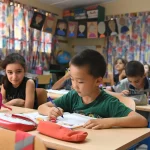
L'’elementary School, Primary school, often called elementary school, is a crucial and fundamental time in a child's life. Indeed, it is during this period that they acquire the basic knowledge and essential skills for their future schooling and personal development.
But what exactly are the objectives of primary school? What is the purpose of the learning offered to children through the different levels? cycles And classes primary education? This article aims to take stock of these questions.
Mastery of fundamental knowledge and common knowledge base
At the heart of primary school lies a central objective: to enable every student to access common core of fundamental skills and knowledge. This foundation aims to provide all students with all the essential knowledge for their future academic success.
Among this fundamental knowledge, we generally identify:
- mastery of elementary arithmetic principles and operations (addition, subtraction, multiplication, etc.)
- understanding and manipulating language (reading, writing, spelling, grammar, etc.)
- the discovery and appropriation of universes specific to the sciences (life and earth sciences, physics and chemistry…), to history and geography or even to artistic teachings (visual arts, music…)
Alongside this assimilation of fundamental knowledge, primary school also pursues another essential objective: the development of skills.
Develop student skills through learning
Indeed, the national education system aims not only to provide students with a body of knowledge but also to develop their ability to use this knowledge in diverse and varied situations. This is how primary school prepares each child to face the challenges and demands of the 21st century, based on a few key skills to master the tasks which will be asked:
- Adaptability: to be able to adapt to new or changing contexts and situations throughout one's life and schooling.
- Reason: be able to mobilize knowledge for a specific purpose, with a view to understanding or solving a problem.
- Work in groups : learn to cooperate and collaborate with peers to carry out collective work.
- Communicate : develop oral and written communication skills to be able to express one's point of view, ideas or project.
- Be independent : know how to manage your time, organize your thoughts and actions to accomplish tasks effectively.
These skills, which go beyond the simple school setting, are developed over the years and cycles, through various projects, group work, individualized exercises and other varied teaching methods put in place by the teaching team.
Distribution of the educational curriculum across the three cycles of primary school
The gradual development of learning in elementary school is structured around three distinct cycles, each having a specific purpose:
- Primary learning cycle: This cycle previously corresponded to the CP and CE1 classes. It serves in particular to consolidate and deepen fundamental learning, such as reading and writing, as well as to gradually discover new areas.
- Fundamental learning cycle: Previously comprised of CE2, CM1, and CM2 classes, it aims to further structure key knowledge and skills across all subjects. Students must then be able to solve more complex problems, analyze documents, synthesize information, and create personal projects.
- Consolidation cycle: Corresponding today to the 6th grade, this cycle allows students to improve their mastery of the fundamental knowledge covered during the previous cycles, with a view to better preparing for entry into 5th grade (first stage of middle school).
It is important to emphasize that throughout all these cycles, the monitoring and evaluation of each student's progress is done through writing diagnostic and formative assessments, the results of which are shared with parents during individual or collective meetings.
Promote civic and inclusive education
Finally, primary school also has the function of welcoming all children and guiding them to become responsible citizens, aware of their rights and responsibilities in society. To achieve this, it relies on several key areas:
- L'’education to citizenship, in particular through collective projects and participation in various decision-making bodies within the school (Student Council, etc.)
- L'’education in respecting others, for example through the fight against discrimination or the promotion of cooperation and mutual support between students.
- THE development openness to the world and to different cultures.
Thus, primary school also aims for an essential goal by developing in the student their civic and social responsibility, so that they become fully aware of their rights and duties as a citizen and a person respectful of others in a multicultural and democratic society.
In conclusion, we can say that elementary school rests on precise and ambitious pedagogical foundations, making it much more than a simple place for traditional learning. Through the mastery of fundamental knowledge, the development of diverse skills, and the promotion of inclusive and civic education, primary school plays a crucial role in shaping each child's personality and opening them up to the world around them.


 English (UK)
  Français